
What Is the Indian Premier League (IPL)?
The Indian Premier League (IPL) is a professional Twenty20 cricket league established by the Board of Control for Cricket in India (BCCI). It brings together franchise teams featuring Indian and overseas players in a short-format tournament.
The IPL was launched in 2008 and quickly became one of the most prominent T20 competitions in world cricket. Its franchise-based model, player auctions, international talent, and short-format matches helped establish its global appeal.
Each IPL season combines a league stage with playoffs and a final, where teams compete for points before the strongest sides advance to the knockout stage
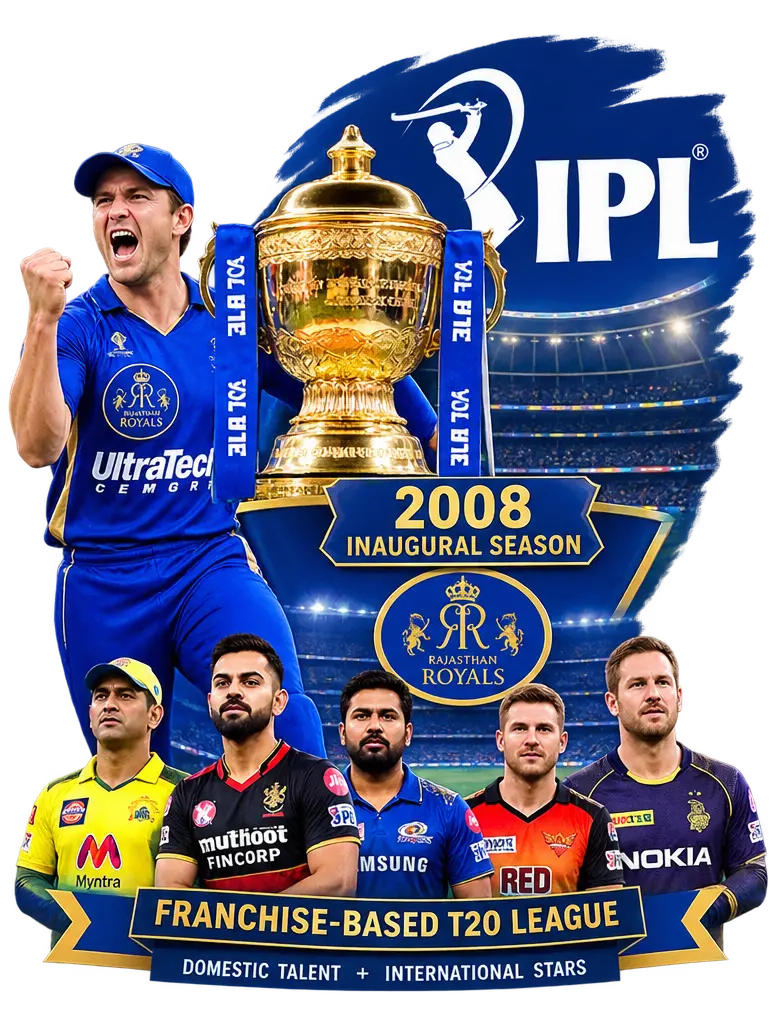
IPL History and Origin
The IPL began in 2008 under the BCCI, with Rajasthan Royals winning the inaugural season. The competition introduced a franchise-based T20 model that changed the commercial landscape of professional cricket in India. Over the years, the league expanded through new franchises, evolving regulations, and its player auction system, bringing domestic cricketers together with established international players.
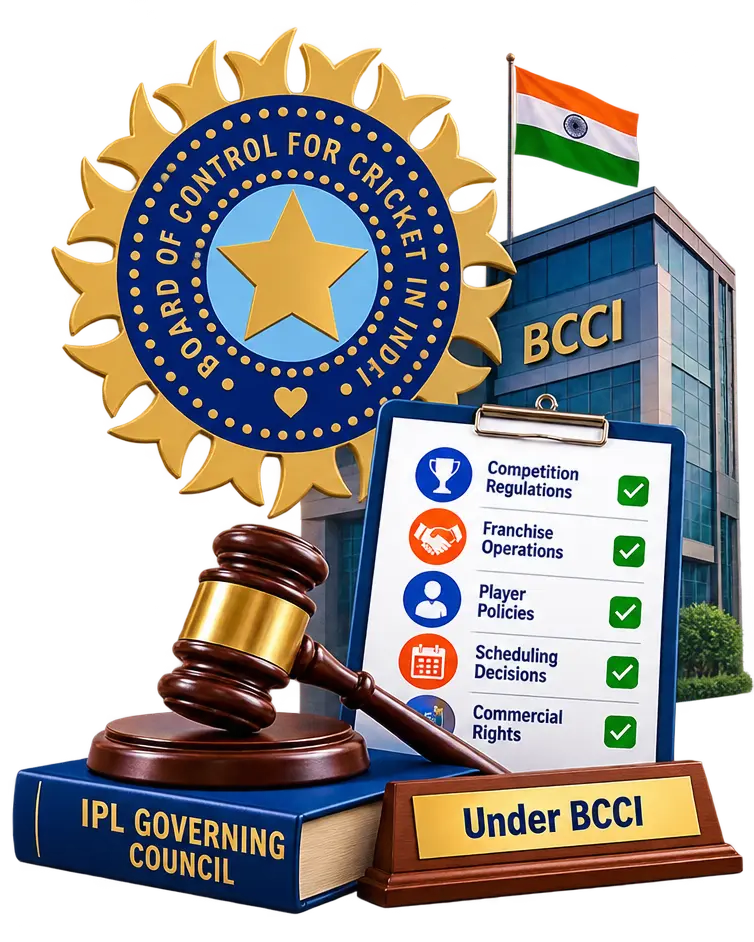
Who Governs the IPL?
The BCCI establishes and organises the IPL, overseeing its administration and governing framework. The IPL Governing Council manages key league-related matters under the BCCI structure. The BCCI also oversees important areas including competition regulations, franchise operations, player policies, scheduling decisions, and commercial rights.
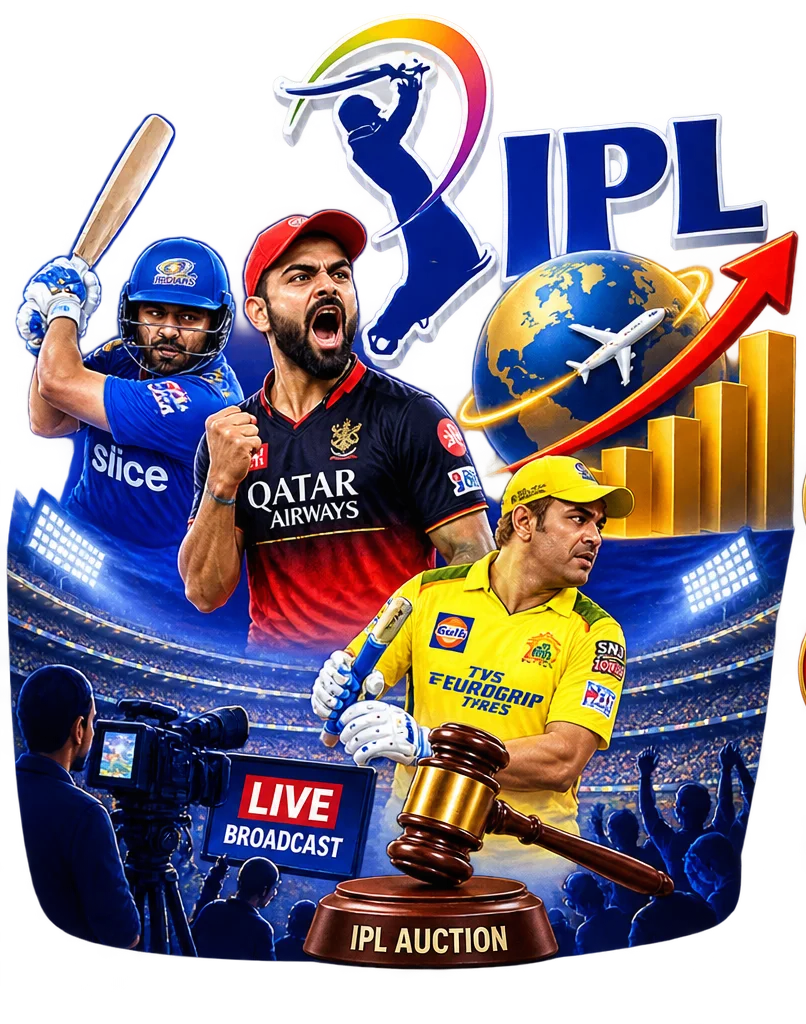
How the IPL Became a Major T20 League
The IPL combined fast-paced T20 cricket with city-based franchises, leading players, extensive broadcasting, and a structured auction system. This created a competition with strong domestic and international appeal. The league also became an important pathway for Indian cricket talent, while attracting leading overseas players and strengthening its position in the global T20 calendar.
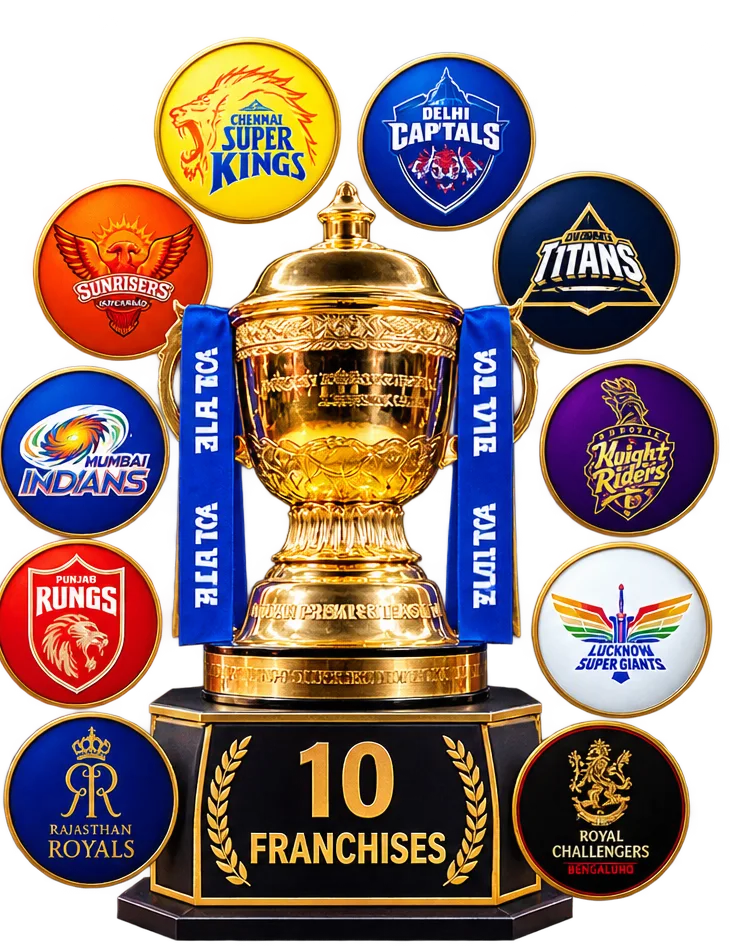
IPL Seasons and Growth
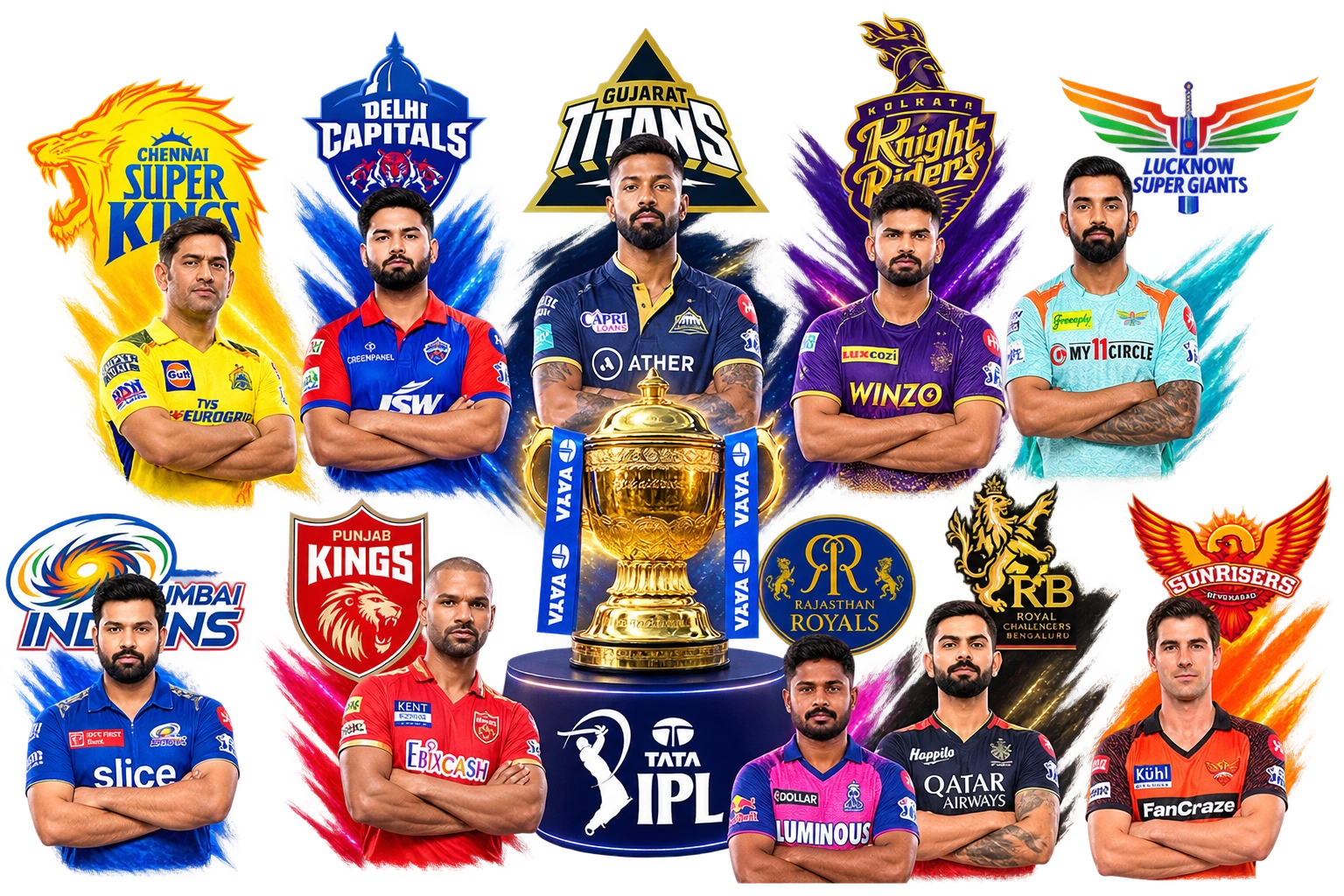
Since its inaugural 2008 season, the IPL has evolved through changes involving teams, competition formats, player regulations, broadcasting arrangements, and commercial partnerships. The league currently features 10 franchises: Chennai Super Kings, Delhi Capitals, Gujarat Titans, Kolkata Knight Riders, Lucknow Super Giants, Mumbai Indians, Punjab Kings, Rajasthan Royals, Royal Challengers Bengaluru, and Sunrisers Hyderabad.
How Does the IPL Tournament Format Work?
The IPL uses a league stage followed by a four-team playoff system to determine the season’s champion.
During the league stage, franchises compete for points and positions in the standings. The top four teams then progress to the playoffs, where their league rankings determine the knockout matchups.
League Stage
The league stage is the longest part of an IPL season, with teams playing multiple matches against other franchises.
Results from these matches determine each team's position in the IPL points table. Recent 10-team seasons have featured 70 league-stage matches before the playoffs.
Points System
A team earns 2 points for a win, while a defeat provides no points. If a match ends without a result, both teams receive 1 point.
When teams finish level on points, the applicable playing conditions use factors such as wins and net run rate to determine their positions.
Playoff Structure
The four highest-ranked teams after the league stage qualify for the playoffs.
The team finishing first plays the second-placed team in Qualifier 1. The third- and fourth-placed teams meet in the Eliminator.
This structure gives the top two teams an additional route to the Final if they lose their first playoff match.
Qualifier 1
Qualifier 1 is contested between the first- and second-placed teams from the league stage.
The winner advances directly to the IPL Final, while the losing team gets another opportunity through Qualifier 2.
Eliminator
The Eliminator features the teams that finish third and fourth in the league standings.
The winner remains in contention for the title and moves into Qualifier 2. The losing team is eliminated from the tournament.
Qualifier 2
Qualifier 2 brings together the loser of Qualifier 1 and the winner of the Eliminator.
The winner earns the second place in the IPL Final and faces the Qualifier 1 winner for the championship.
IPL Final
The IPL Final is played between the winners of Qualifier 1 and Qualifier 2.
The winning team becomes the IPL champion for that season. If a playoff match is tied, the playing conditions provide for a Super Over, with additional procedures applying when required.
What Are the Rules of IPL Cricket?
IPL matches follow standard T20 cricket principles along with competition-specific playing conditions issued for the tournament. These rules cover the match format, powerplay, strategic timeouts, player substitutions, reviews, tie-breakers, and other playing procedures.
T20 Match Format
An IPL match consists of two innings, with each team normally receiving a maximum of 20 overs.
The team scoring more runs wins the match. An innings can finish earlier if the batting side loses all its wickets or reaches the required target.
Powerplay Rules
The first six overs of an IPL innings form the powerplay, during which fielding restrictions apply.
Only a limited number of fielders can remain outside the designated inner fielding circle during this period, creating greater opportunities for aggressive batting.
Strategic Timeouts
Each IPL innings includes two strategic timeouts of 2 minutes and 30 seconds in an uninterrupted 20-over innings.
One timeout is taken during the middle phase of the innings, while the other occurs during the later stages. The timing can be selected within specified overs under the playing conditions.
Impact Player Rule
The Impact Player rule allows a team to introduce a designated substitute during a match under specific conditions.
The regulation has been retained for the 2025–2027 IPL cycle, making it an important part of squad and match strategy.
Teams can use the rule to alter their combination during the game, depending on match conditions and tactical requirements.
Super Over Rules
A Super Over is used as a tie-breaker when the required playing conditions result in a tied match.
Each side gets a limited opportunity to score runs, with the team producing the higher total winning the Super Over.
If the tie remains unresolved, additional Super Overs can be used according to the applicable IPL playing conditions.
DRS and Match Review
Rules
The Decision Review System (DRS) allows teams to challenge certain on-field umpiring decisions under the tournament’s review procedures.
IPL matches use approved technologies including ball tracking and sound-based edge detection as part of the DRS setup.
The third umpire reviews the available evidence and communicates the final decision to the on-field umpire.
Who Are the IPL Teams?
The IPL currently features 10 franchise teams representing different Indian cities and regions. Each franchise builds its squad through player retention, releases, trades, and the IPL auction, combining Indian and overseas players.
Chennai Super Kings
Chennai Super Kings (CSK) represent Chennai and are among the most successful franchises in IPL history. The team plays its home matches at the M. A. Chidambaram Stadium and has built a strong identity around experienced players and consistent performances.
CSKDelhi Capitals
Delhi Capitals (DC) represent Delhi and compete in the IPL as one of the league's established franchises. The team uses the Arun Jaitley Stadium as its primary home venue and has regularly featured a combination of Indian and international players.
DCGujarat Titans
Gujarat Titans (GT) are based in Ahmedabad and entered the IPL in 2022 as one of the league's newer franchises. The team plays its major home fixtures at the Narendra Modi Stadium and won the IPL title in its debut season.
GTKolkata Knight Riders
Kolkata Knight Riders (KKR) represent Kolkata and are one of the IPL's most recognised franchises. Their home ground is Eden Gardens, where the team benefits from one of the league's largest and most distinctive cricket venues.
KKRLucknow Super Giants
Lucknow Super Giants (LSG) represent Lucknow and joined the IPL in 2022. The franchise plays home matches at the Bharat Ratna Shri Atal Bihari Vajpayee Ekana Cricket Stadium and has developed its squad through a mix of domestic and overseas talent.
LSGMumbai Indians
Mumbai Indians (MI) represent Mumbai and are one of the most successful teams in IPL history. Their primary home venue is Wankhede Stadium, with the franchise known for its strong record, experienced squad-building approach, and extensive IPL history.
MIPunjab Kings
Punjab Kings (PBKS) represent the Punjab region and have competed in the IPL since its inaugural season. The franchise has used multiple venues for home matches over different seasons, with the 2026 schedule featuring New Chandigarh and Dharamshala as home venues.
PBKSRajasthan Royals
Rajasthan Royals (RR) represent Rajasthan and were the inaugural IPL champions in 2008. The team primarily represents Jaipur and has also used Guwahati as a home venue, particularly for selected matches in recent seasons.
RRRoyal Challengers Bengaluru
Royal Challengers Bengaluru (RCB) represent Bengaluru and are among the IPL's most followed franchises. The team traditionally plays its home matches at M. Chinnaswamy Stadium and won its first IPL title in 2025.
RCBSunrisers Hyderabad
Sunrisers Hyderabad (SRH) represent Hyderabad and entered the IPL in 2013. The franchise plays its home matches at the Rajiv Gandhi International Stadium and won its first IPL title in 2016.
SRHWhich Stadiums Host IPL Matches?
IPL matches are played at major cricket stadiums across India, with venues selected according to franchise home arrangements, scheduling requirements, and tournament logistics. The number and location of venues can change between seasons, while some teams may use secondary home grounds for selected matches.
IPL Stadiums
Major IPL Stadiums in India
Important IPL venues include the Narendra Modi Stadium in Ahmedabad, M. Chinnaswamy Stadium in Bengaluru, M. A. Chidambaram Stadium in Chennai, and Arun Jaitley Stadium in Delhi.
Other major venues include Eden Gardens in Kolkata, Ekana Cricket Stadium in Lucknow, Wankhede Stadium in Mumbai, and Rajiv Gandhi International Stadium in Hyderabad.
Recent seasons have also featured venues such as the HPCA Stadium in Dharamshala, Sawai Mansingh Stadium in Jaipur, and New Chandigarh's international cricket stadium.
Stadium Capacity
IPL venues vary significantly in seating capacity.
The Narendra Modi Stadium in Ahmedabad can accommodate around 132,000 spectators, making it the world's largest cricket stadium.
Home Grounds and Pitch Characteristics
Each franchise generally has a designated home venue, but scheduling requirements can result in matches being moved to secondary grounds.
Pitch characteristics also vary between venues. Surface pace, bounce, boundary dimensions, weather, humidity, and dew can influence batting and bowling conditions.
How Venue Conditions Affect Matches
Venue conditions can influence team selection, bowling combinations, batting approach, and decisions at the toss.
Fast surfaces may provide greater assistance to pace bowlers, while slower or spin-friendly pitches can make shot-making more difficult and increase the value of spin bowling.
Dew during evening matches can also affect grip for bowlers and make chasing more favourable in certain conditions.
IPL Points Table
IPL Points Table
The IPL points table ranks teams according to their results during the league stage and determines which franchises advance to the playoffs.
Points, wins, losses, no-results, and net run rate are important factors when teams compete for the top four positions.
How IPL Points Are Awarded
A team receives 2 points for every win and 0 points for a loss.
If a match produces no result, each participating team receives 1 point. The applicable playing conditions also provide points for certain matches that cannot commence.
The team with the highest points occupies the top position in the league table.
Net Run Rate Explained
Net run rate (NRR) measures the difference between a team's average runs scored per over and its average runs conceded per over.
NRR becomes particularly important when teams finish the league stage with equal points and equal numbers of wins.
A stronger positive NRR can therefore provide a crucial advantage in the playoff qualification race.
How Teams Qualify for the Playoffs
The four teams with the highest positions in the league table qualify for the IPL playoffs.
The first-placed team faces the second-placed team in Qualifier 1, while the third- and fourth-placed teams meet in the Eliminator.
League performance therefore affects both playoff qualification and the route teams receive through the knockout stage.
Schedule IPL Match
The IPL schedule determines when and where league, playoff, and final matches are played during each season.
The BCCI announces the schedule in phases when required, with dates and venues sometimes adjusted because of operational or logistical considerations.
How the IPL Schedule Is Created
The BCCI prepares the IPL schedule by considering franchise home venues, travel requirements, broadcasting arrangements, local events, and other logistical factors.
The final schedule assigns opponents, match dates, starting times, and venues while maintaining the required tournament structure.
League Matches
In a 10-team IPL season, the league stage consists of 70 matches before the four playoff fixtures.
Teams play their scheduled opponents according to the season’s competition format, with results determining positions in the points table.
Double-Headers
A double-header is a day on which two IPL matches are played.
The first match is generally scheduled in the afternoon, while the second match takes place in the evening. Double-headers help accommodate the large number of league fixtures within the tournament window.
Playoff Schedule
The playoffs consist of Qualifier 1, the Eliminator, Qualifier 2, and the Final.
The BCCI announces the playoff venues and dates separately when necessary. In 2026, Qualifier 1 was held in Dharamshala, the Eliminator and Qualifier 2 in New Chandigarh, and the Final in Ahmedabad.
How Match Dates and Venues Are Confirmed
The published schedule is the primary reference for confirmed match dates, timings, opponents, and venues.
The BCCI can revise fixtures when required, so official IPL and BCCI announcements should be checked for schedule changes.
IPL Records and Statistics
IPL records highlight outstanding individual and team performances across the history of the competition.
The most important records cover career runs and wickets, individual scores, team totals, successful chases, centuries, sixes, and single-season performances.
Most IPL Titles
Chennai Super Kings and Mumbai Indians have won the most IPL titles, with five championships each.
Kolkata Knight Riders have won three titles, while Royal Challengers Bengaluru have two titles after winning consecutive championships in 2025 and 2026.
Most Career Runs
Virat Kohli is the IPL's leading run-scorer, having crossed 9,000 career runs after the 2026 season.
His long association with Royal Challengers Bengaluru has made him the most prolific batter in IPL history by aggregate runs.
Most Career Wickets
Yuzvendra Chahal holds the record for the most IPL wickets.
He reached 200 wickets during his career and finished the 2026 season with 233 wickets, remaining ahead of the other leading wicket-takers.
Highest Individual Score
Chris Gayle holds the record for the highest individual IPL score with an unbeaten 175 for Royal Challengers Bengaluru against Pune Warriors India in 2013.
The innings came from 66 balls and included 13 fours and 17 sixes.
Highest Team Total
Sunrisers Hyderabad hold the record for the highest team total in IPL history.
They scored 287/3 against Royal Challengers Bengaluru in 2024, surpassing their previous record of 277/3 against Mumbai Indians earlier in the same season.
Highest Successful Chase
Punjab Kings hold the record for the highest successful run chase in IPL history.
They chased 262 against Kolkata Knight Riders in 2024, reaching 262/2 with eight balls remaining.
Fastest Century
Chris Gayle holds the record for the fastest IPL century.
He reached 100 from only 30 balls against Pune Warriors India in 2013 during his record-breaking 175 not out.
Most Sixes
Chris Gayle has hit the most sixes in IPL history, with 357 maximums during his career.
His record remains ahead of the active players who have accumulated the highest six totals across multiple IPL seasons.
Most Runs in a Single Season
Virat Kohli holds the record for the most runs in a single IPL season.
He scored 973 runs for Royal Challengers Bengaluru in 2016, including four centuries and seven half-centuries.
IPL Winners by Season
The IPL has produced multiple champions since its first season in 2008, with Mumbai Indians and Chennai Super Kings leading the championship list.
The winners’ history also shows how different franchises have dominated specific periods of the competition.
IPL Winners by Season
IPL Runners-Up by Season
Teams With the Most IPL Titles
Mumbai Indians and Chennai Super Kings have won five IPL titles each. Kolkata Knight Riders have three championships, while Rajasthan Royals, Sunrisers Hyderabad, Gujarat Titans, and Royal Challengers Bengaluru have each won at least one title.
IPL Final Venues and Results
IPL Finals have been hosted across major venues including Wankhede Stadium, Eden Gardens, M. Chinnaswamy Stadium, and Narendra Modi Stadium. Recent finals include KKR defeating SRH in 2024, RCB defeating PBKS in 2025, and RCB defeating GT in 2026.
IPL Orange Cap
The Orange Cap is awarded to the batter who scores the most runs during an IPL season, including the playoff matches. The award recognises the tournament's leading run-scorer and has become one of the IPL's most prominent individual honours.
What Is the Orange Cap?
The Orange Cap is presented to the highest run-scorer of an IPL season. The leading run-scorer can change during the tournament as players accumulate runs, with the final award determined after the competition concludes.
Orange Cap Winners by Season
Most Orange Cap Wins
David Warner has won the Orange Cap three times, making him the most frequent winner of the award. Chris Gayle and Virat Kohli have each won the Orange Cap twice.
Highest Runs in an IPL Season
Virat Kohli holds the record for the highest run tally in a single IPL season. He scored 973 runs for Royal Challengers Bengaluru in 2016, a record that remains unbeaten.
IPL Purple Cap
The Purple Cap is awarded to the bowler who finishes an IPL season with the most wickets. Like the Orange Cap, the award can change hands throughout the season as bowlers compete for the leading wicket-taking position.
What Is the Purple Cap?
The Purple Cap recognises the leading wicket-taker across an IPL season, including the playoff matches. It rewards bowlers who consistently take wickets and contribute to their team's progress throughout the competition.
Purple Cap Winners by Season
Most Purple Cap Wins
Bhuvneshwar Kumar and Dwayne Bravo have each won the Purple Cap twice. Several other leading IPL bowlers have won the award once, including Lasith Malinga, Kagiso Rabada, Yuzvendra Chahal, Mohammed Shami, and Harshal Patel.
Most Wickets in an IPL Season
The record for the most wickets in a single IPL season is 32. Dwayne Bravo reached 32 wickets for Chennai Super Kings in 2013, before Harshal Patel matched the record for Royal Challengers Bengaluru in 2021.
How Does IPL Cricket Differ From Other T20 Leagues?
The IPL is different from many other T20 leagues because of its franchise structure, player auction system, Indian talent pool, and playoff format. Its combination of domestic and overseas players creates a competition where franchises build squads around specific team requirements and salary constraints.
Franchise-Based Competition
The IPL operates through privately owned franchise teams representing Indian cities and regions. Unlike international cricket, players from different countries compete together for franchises, creating teams that combine domestic and overseas talent.
Indian and Overseas Players
IPL squads include Indian players alongside international cricketers from different countries. A team can field a maximum of four overseas players in its playing XI, making the balance between Indian and overseas talent an important squad-building consideration.
Auction and Squad-Building System
The IPL uses a structured player auction where franchises compete for available players using their allocated salary purse. Teams can also retain players and use permitted Right to Match options, allowing franchises to maintain core squads while adding new players through auctions.
League and Playoff Structure
The IPL uses a league stage followed by a four-team playoff system. The Qualifier 1 and Eliminator format gives the top two league teams an additional opportunity to reach the Final, creating a different qualification route from many other T20 competitions.
IPL Player Auction
The IPL Player Auction is the process through which franchises acquire players who are available for selection. Teams use their remaining salary purse to compete for players while following squad-size, overseas-player, retention, and auction regulations.
13.1 How the IPL Auction Works
Players register for the auction and are placed into different categories based on their status and selected reserve price. During the auction, franchises bid for players. The highest valid bid secures the player's services, subject to the applicable IPL regulations.
13.2 Player Retention and Releases
Franchises can retain selected players before an auction and release others from their existing squads. Under the 2025–27 player regulations, teams can retain or acquire up to six players through retention and Right to Match options, subject to limits on capped and uncapped players.
13.3 Auction Categories
Auction players are classified according to factors such as capped or uncapped status, Indian or overseas status, and their selected reserve price. For the 2026 auction, the reserve-price brackets ranged from ₹30 lakh to ₹2 crore, with players choosing their applicable base price before the auction.
13.4 Overseas Player Rules
Overseas players are subject to specific registration and squad restrictions. Under the 2025–27 regulations, overseas players must register for the Big Auction to remain eligible under the applicable auction rules. Teams can also include a maximum of four overseas players in their playing XI.
13.5 How Teams Build Their Squads
Franchises use the auction to address gaps in batting, bowling, wicketkeeping, all-round ability, and squad depth. Teams must balance player requirements against their available salary purse and overseas-player slots while building a squad within the permitted limits.
IPL Betting Markets
IPL betting markets allow users to predict outcomes and statistical events related to matches, players, and the overall tournament. The availability of specific markets varies by bookmaker, match, competition stage, and applicable local regulations.
1. IPL Match Winner
The match-winner market involves predicting which team will win a particular IPL match. It is one of the simplest cricket betting markets because the selection is based on the expected winner between the two competing teams.
2. IPL Top Batter and Top Bowler
Top-batter markets involve predicting which player will score the most runs in a match or tournament. Top-bowler markets similarly focus on the player expected to take the most wickets, depending on the specific market offered.
3. IPL Total Runs Over/Under
Over/under markets involve predicting whether a selected total will be exceeded or remain below a specified line. Depending on the bookmaker, markets can cover team totals, match totals, innings runs, or other statistical outcomes.
4. Player Performance Markets
Player-performance markets focus on individual statistics such as runs, wickets, fours, sixes, or other match-specific achievements. These markets require consideration of factors including player form, batting position, expected playing XI, opposition, and venue conditions.
5. IPL Tournament Winner
The tournament-winner market involves selecting the franchise expected to win the IPL title. These markets are usually available before and during the tournament, with prices changing as teams progress through the season.
6. IPL Betting Odds Explained
Betting odds represent the price assigned to a particular outcome and indicate the potential return based on the stake. Odds can change according to team news, player availability, match conditions, results, and market demand.
IPL Live Scores and Match Information
IPL live score services provide current match information while games are being played and detailed results after matches finish. Important information includes the score, wickets, overs, batting figures, bowling figures, required run rate, and match result.
1. Live IPL Scores
Live scores show the current innings score, wickets, overs completed, and target during an ongoing match. They allow users to follow match progress without watching the full broadcast.
2. Ball-by-Ball Updates
Ball-by-ball coverage records individual deliveries and their outcomes throughout an innings. Updates can include runs, wickets, boundaries, extras, partnerships, bowling changes, and other important events.
3. IPL Points Table
The live points table tracks each team's matches, wins, losses, points, and net run rate. It becomes particularly important near the end of the league stage when small differences in results or net run rate can determine playoff qualification.
4. Match Results and Scorecards
Completed IPL matches have detailed scorecards showing both innings and individual player performances. A scorecard normally includes batting scores, dismissals, bowling figures, extras, partnerships, fall of wickets, and the final result.
IPL 2027 Information and Updates
IPL 2027 will be the 20th season of the Indian Premier League and is currently covered by the player regulations announced for the 2025–2027 cycle. The core competition framework is already established, while the final schedule, auction details, squads, and venues will depend on official announcements.
What Is Known About IPL 2027?
The IPL 2027 season is covered by the current 2025–27 player regulations approved by the IPL Governing Council. The regulations allow franchises to retain or acquire up to six players through retention and Right to Match options, subject to applicable player limits. The Impact Player rule is also scheduled to continue through the 2027 season.
IPL 2027 Schedule Updates
The official IPL 2027 match schedule has not yet been announced. The schedule will confirm the league fixtures, match dates, starting times, venues, double-headers, and playoff arrangements once released by the BCCI and IPL.
IPL 2027 Teams and Squad Updates
The IPL currently has 10 franchises, and the existing 2025–27 regulations apply to these teams. Final 2027 squads will depend on player retentions, releases, trades, auction selections, replacements, and other roster decisions made before the season.
IPL 2027 Venue and Format Updates
The final list of IPL 2027 venues and the complete match allocation have not yet been officially announced. The tournament is expected to operate under the established league-and-playoff framework unless the IPL Governing Council announces changes to the competition format.
When Official IPL 2027 Information Is Announced
Important IPL 2027 information will be released in stages rather than through one announcement. Player retention details, auction information, squad updates, and the final schedule are expected to be announced separately. The official IPL and BCCI websites should be treated as the primary sources for confirmed updates.
Frequently Asked Questions About the IPL
The IPL currently has 10 teams: Chennai Super Kings, Delhi Capitals, Gujarat Titans, Kolkata Knight Riders, Lucknow Super Giants, Mumbai Indians, Punjab Kings, Rajasthan Royals, Royal Challengers Bengaluru, and Sunrisers Hyderabad.
A 10-team IPL season currently has 70 league-stage matches, followed by four playoff matches involving the top four teams.
This produces 74 matches in total when the Qualifier 1, Eliminator, Qualifier 2, and Final are included.
A team earns 2 points for a win and receives no points for a loss.
When a match produces no result, both teams generally receive 1 point under the applicable playing conditions.
Four teams qualify for the IPL playoffs after the league stage.
The first- and second-placed teams play Qualifier 1, while the third- and fourth-placed teams play the Eliminator.
Chennai Super Kings and Mumbai Indians have won the most IPL titles, with five championships each.
The Impact Player rule allows a team to introduce a designated substitute during a match under specified IPL regulations.
The rule is scheduled to remain in effect throughout the 2025–2027 IPL cycle.
Common IPL betting markets include match winner, tournament winner, top batter, top bowler, total runs, player performance, and other match-specific statistical markets.
Market availability varies between betting operators and may also depend on local laws and regulations.
IPL betting laws in India depend on the applicable state or union territory and the specific type of betting activity.
Users should check the current laws applicable to their location before participating in any betting activity.